


BurgundyMany of our favourite wines come from this region which is in the climatic margin for successful Pinot Noir. However, the allure of Burgundy (and the exponential price rises of top Bordeaux in recent en primeur campaigns) has increased demand for the top names and, in tandem with this, prices have risen accordingly. We tasked ourselves with sourcing affordable wines offering high quality. We believe we have succeeded so far! From north to south, we work with the following estates in Burgundy (click on the estate name to be taken to a different page):
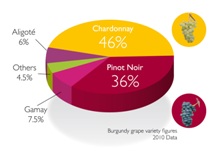
Burgundy conjures up images of classic but expensive wines beyond reach. Indeed, some of the world’s finest wines hail from the region and many less conscientious producers take advantage of this by producing inferior wines at inflated prices. This makes it essential either to follow recommendations of friends or reliable critics or just to take the plunge. The two main grapes in Burgundy are Pinot Noir for the reds and Chardonnay for the whites. Pinot Noir is a fragile variety which is easily spoilt by excessive fining and filtration so it is better to accept some sediment in even a fairly young wine rather than the loss of fruit and body. The better producers are waking up to this and minimal clarification is now practiced at the better estates. Chardonnay is the world's favourite white wine variety and, as such, needs little introduction. However, for all the efforts of so many New World producers as well as many in France, Italy and Spain, the soils and climate of Burgundy are so well suited to this variety that in the best years unrivalled Chardonnays are produced in Chablis, the Côte de Beaune, the Chalonnaise and the Maconnaise.
Perhaps the most complicated wine region to come to grips with, the Côte
d'Or is not, in fact, the "golden slope" but an abbreviation of Côte
d'Orient, so-called because the very best slopes are to the east. The northern
section, the Côte de Nuits, produces great red wines exclusively from Pinot
Noir. Heading south from Beaune, the Côte de Beaune produces elegant reds and
the finest Chardonnays. Further south is the Côte Chalonnaise, home to such
villages as Givry, Rully and Mercurey where some of the best value Pinots and
Chardonnays can be found.
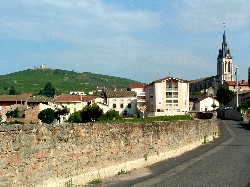
Whilst technically the southernmost region of Burgundy, the Beaujolais is in many ways a different world. Whereas the principal grape for red wines further north is Pinot Noir, the Beaujolais is the home of the Gamay grape. It is, perhaps, best known for Beaujolais Nouveau, a very light wine which appears on the shelves every November on the third Thursday (known as "Beaujolais Day"). These first releases are simple, often one-dimensional, light wines for immediate drinking and, unfortunately, many people have the impression that all Beaujolais wines are in this mould. In fact, the region produces some excellent wines in ten village appellations, known as the Crus, of which Fleurie is, perhaps, the best known in the UK. With only a few years’ bottle age, the quality of the Gamay fruit grown here can be rich enough to trick connoisseurs into believing that they are drinking mature Pinot Noir. Photographs: the Chapel of the Madonna, Fleurie and the village of Fleurie (the chapel is high on the hill in the distance) With the exception of 1992, the nineties witnessed a run of very
good to excellent vintages, and since the Millenium, almost every vintage has
been successful. Gamay does not seem to give too many headaches in the growing
stages at least. |
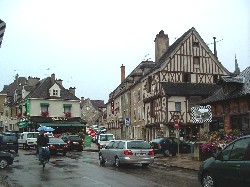 Chablis is the most northern of Burgundy's wine-producing districts
(hence this photograph taken in the rain on an otherwise hot August day) consisting of around 7,500 acres of Chardonnay vines in the Yonne département,
over 60 miles north of Beaune. There are four levels within the appellation
which was created in 1938 - from the top:
Chablis is the most northern of Burgundy's wine-producing districts
(hence this photograph taken in the rain on an otherwise hot August day) consisting of around 7,500 acres of Chardonnay vines in the Yonne département,
over 60 miles north of Beaune. There are four levels within the appellation
which was created in 1938 - from the top: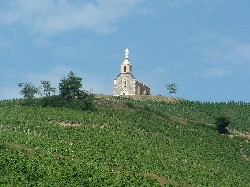
|
You must be aged 18 or over to purchase wine. |